
Going through a divorce yourself? This site is the professional association. Your guidance lives on DivorceHousing.com.
Take me thereYour home is usually the largest asset in a divorce, and the mortgage attached to it is the one nobody checks until the agreement is already signed.
A settlement agreement is a legal document. A mortgage is a financial one. They do not automatically agree, and when they disagree it is discovered months later, at a lender, by the person who was awarded the house.
A Certified Divorce Lending Professional is a licensed mortgage professional who has been trained and credentialed to work that problem while the agreement is still a draft.
Can this actually be done?
Whether a refinance or a buyout will be approved under real lending guidelines, not whether it sounds reasonable at the table.
What will count?
A divorce can create several income streams. Some qualify, some do not, and how the agreement is written often decides which.
Before it is final
Most of what makes a housing outcome work can still be changed while the agreement is in draft. Very little of it can be changed afterward.
A written report about your home, not an opinion
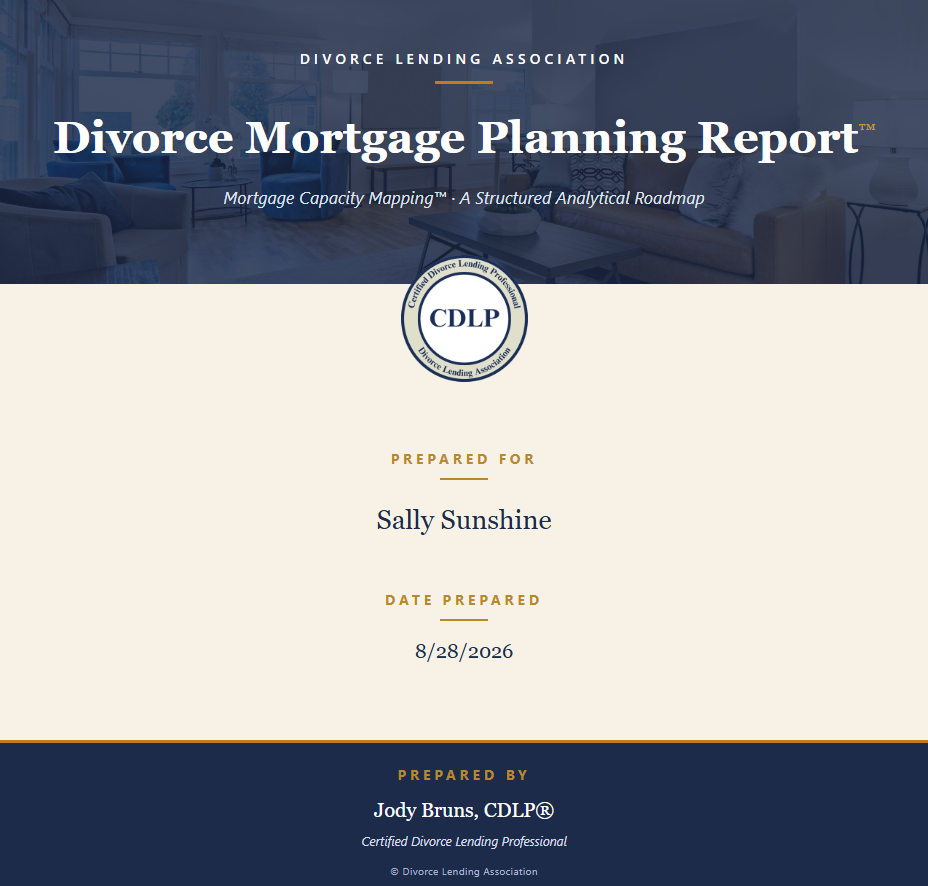
When a CDLP® works with you, what you receive is the Divorce Mortgage Planning Report™: a written analysis of whether the plan for your home can actually work, prepared before your agreement is signed. You can share it with your attorney while the terms can still change.
The questions it answers
- Can I keep the house, and can I afford to keep it after the divorce?
- Will my support count as income when I apply for a loan?
- What would a buyout or a refinance actually cost each month?
- If I move out, can I buy my next home?
- What are the risks, and what could change the answer?
What it is not. It is not a loan estimate, a preapproval or a promise that any lender will approve a loan. It is not legal or tax advice.
Working things out together? A Certified Divorce Housing Neutral™ prepares a Neutral Edition of the report for both of your households at once.
A CDLP® works alongside your attorney, not in place of one
This matters, so we will be direct about it. A CDLP® does not give legal advice, does not represent you, and does not replace your attorney or your tax professional. They work the financing question and stay inside it.
Certification also does not obligate anyone to lend to you, and no analysis can guarantee that a lender will approve a loan.
The credential is one you can check. The Divorce Lending Association grants the CDLP® designation, publishes the practice standards and code of ethics it is held to, and maintains a public national directory. A credential that cannot be lost does not mean much, so before you rely on anyone, confirm they are listed and in current standing.
When you both want one answer about the house
If you and your spouse are working things out together, in mediation or a collaborative divorce, ask your attorneys or your mediator about a Certified Divorce Housing Neutral™. Instead of each of you hearing about the house from a different side, a housing neutral is hired by both of you together, or appointed by the court, and tests every housing option for both of your households the same way.
You both receive the same report at the same time. Where the two of you disagree about a number, such as an income or the home's value, the housing neutral runs both versions and shows you where it matters, without choosing between them. And a housing neutral never takes a loan for either of you in your case, so they have no stake in which option you choose.
Three designations, and who each one works for
You may see three sets of letters after a professional's name. They are not ranks. Each one names a different role, and one professional can hold more than one.
Works for you
A licensed mortgage professional trained in divorce, who plans your housing and financing while your agreement is a draft and can help with your loan.
Works for neither of you, and serves you both
A CDLP® trained to serve both spouses as a neutral on the house. Hired by both of you, or appointed by the court, and never does a loan for either of you in your case.
Trained for mediation
A real estate professional or CDLP® with mediation skills training, who knows how to work on your home decision inside a mediation or collaborative divorce.
One thing to know first: a professional who has already advised one of you about your divorce cannot later serve as your neutral. If you think you may want a housing neutral, talk with your spouse or your attorney before either of you books a one-on-one review.
Everything written for you is on DivorceHousing.com
This site sets the standards and certifies the professionals. That site is the one built for the homeowner going through it.
- What actually happens to the house
- How buyouts and refinances really work
- Budget, buyout and debt division calculators
- A guide for every state
- What the Divorce Mortgage Planning Report™ covers
- A free strategy review
- How to find and vet a CDLP®
Prefer to search the register first? Find a CDLP® near you and confirm their standing before you rely on anyone. For a real estate professional trained in mediation, use Find a REM-S™.
Are you an attorney, mediator or financial professional? Our reference for family law professionals covers feasibility, liability, valuation, income, title and settlement drafting.